Qualifying Conditions for Medical Marijuana in Georgia
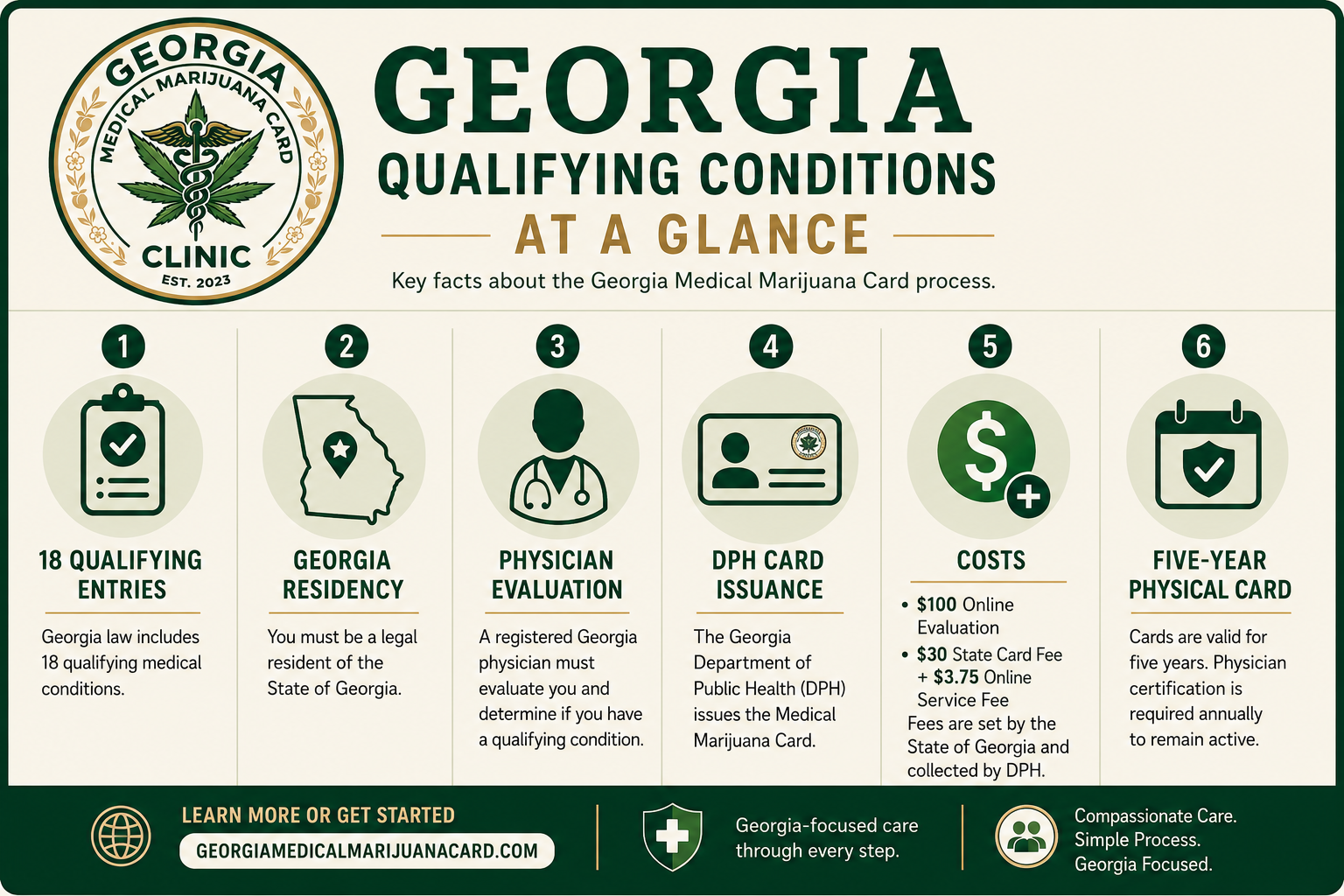
Georgia residents may qualify for a Medical Cannabis card when they have a condition on the state’s qualifying list and a fully licensed Georgia physician determines that certification is medically appropriate. Georgia’s qualifying conditions for medical marijuana include 18 entries, with examples such as ALS, cancer other than non-metastatic skin cancer, intractable pain, PTSD tied to trauma exposure, and seizure disorders related to epilepsy or trauma.
Having a listed diagnosis does not automatically mean that a patient will be certified or receive a card. Some conditions have specific age, stage, severity, diagnosis, or trauma-exposure requirements, and the physician—not the clinic or the State of Georgia—decides whether certification is medically appropriate. Georgia officially uses the terms Medical Cannabis Patient Registry and Medical Cannabis card, although many patients search for a “Georgia medical marijuana card.”
For Georgia residents with one or more qualifying conditions who want legal access to medical cannabis, this guide explains the rules and steps that determine eligibility. It covers the qualifying-condition list, physician certification, required patient documents, state registry card issuance and renewal, caregiver participation, and how telehealth evaluations fit into the process so you can understand how to apply safely and in compliance with Georgia law.
$100 · Private 15-minute phone consultation with a Georgia-licensed physician. GMMC serves adults age 18 and older throughout Georgia.
Book on Calendly. Our team sends an eVisit link for your telemedicine visit. Payment is collected through eVisit after the visit. If our physician determines that you do not qualify for medical cannabis certification, any consultation fee paid will be refunded.

Who Manages Georgia’s Medical Cannabis Program?
Georgia’s current Medical Cannabis Patient Registry requirements reflect the 2026 Putting Georgia’s Patients First Act. Use current DPH guidance for eligibility and the Commission’s guidance for products and authorized sellers.
The Georgia Access to Medical Cannabis Commission has a different role. It helps regulate licensed dispensaries, independent pharmacies, and other licensed businesses under the state system, while overseeing key rules tied to patient access and Georgia's program.
A physician evaluation, physician certification, DPH registry verification, card issuance, and purchasing through licensed dispensaries or authorized pharmacies are separate steps.
What Conditions Qualify for a Medical Marijuana Card in Georgia?
The listed qualifying medical conditions include amyotrophic lateral sclerosis, Alzheimer's disease, multiple sclerosis, sickle cell disease, and inflammatory bowel disease. Adult post traumatic stress disorder resulting from direct exposure to or witnessing trauma is also listed. A physician reviews the diagnosis and applicable criteria for each patient.
Georgia’s current official patient guidance lists the following 18 qualifying categories. The physician reviews the documented condition and determines whether certification is appropriate.
Read the Georgia medical card eligibility guide for an overview of qualifying conditions, required records and consultation steps.
Condition |
Notes from the current state list |
|---|---|
Physician assessment required |
|
Physician assessment required |
|
Adult autism spectrum disorder; GMMC serves adults only |
|
Cancer except non-metastatic skin cancer |
|
Physician assessment required |
|
Inpatient or outpatient hospice enrollment |
|
Stage III human immunodeficiency virus |
|
Includes Crohn’s disease |
|
Documented diagnosis of intractable pain |
|
Physician assessment required |
|
Physician assessment required |
|
Physician assessment required |
|
Physician assessment required |
|
Severe peripheral neuropathy |
|
Adult PTSD resulting from direct exposure to or witnessing trauma |
|
Related to epilepsy or trauma-related head injuries |
|
Physician assessment required |
|
Physician assessment required |
|
The state program has separate rules for minors, including severe autism. GMMC’s service is for adults age 18 and older. A legal guardian or legal custodian does not change our adults-only consultation scope. | |
Ready to discuss your eligibility?
Book a private 15-minute phone consultation for $100. GMMC serves adults age 18 and older throughout Georgia. Payment is collected through eVisit after your visit.
Review consultation and state feesMeet Dr. Andre Haynes
A listed condition does not guarantee certification or state card approval.
Important Georgia Eligibility Distinctions
Chronic pain does not automatically qualify
Georgia recognizes intractable pain as a qualifying condition. Chronic pain in general does not appear separately on the current qualifying list.
A patient should not assume that recurring, persistent, or long-term pain automatically meets Georgia’s intractable-pain requirement. A licensed physician must evaluate the documented diagnosis, medical history, and current condition.
Learn more about intractable pain and Georgia medical cannabis eligibility.
Anxiety and PTSD are not interchangeable
Anxiety by itself is not included on Georgia’s qualifying-condition list.
PTSD may qualify, but the patient must be at least 18 and the condition must result from directly experiencing or witnessing a trauma. The physician must still determine whether certification is medically appropriate.
Learn more about PTSD qualification requirements in Georgia.
Not every cancer diagnosis is treated the same
Georgia lists any cancer except skin cancer, unless the skin cancer is metastatic.
Having an eligible cancer diagnosis does not automatically result in certification. The physician must evaluate the patient and decide whether certification is medically appropriate.
Learn more about cancer and Georgia medical cannabis eligibility.
Seizure disorders have a specific diagnosis requirement
Georgia’s list covers seizure disorders related to a diagnosis of epilepsy or trauma-related head injuries.
A history of an isolated seizure does not necessarily establish eligibility. The physician must evaluate the patient’s diagnosis and relevant medical information.
Learn more about epilepsy, seizure disorders, and Georgia medical cannabis eligibility.
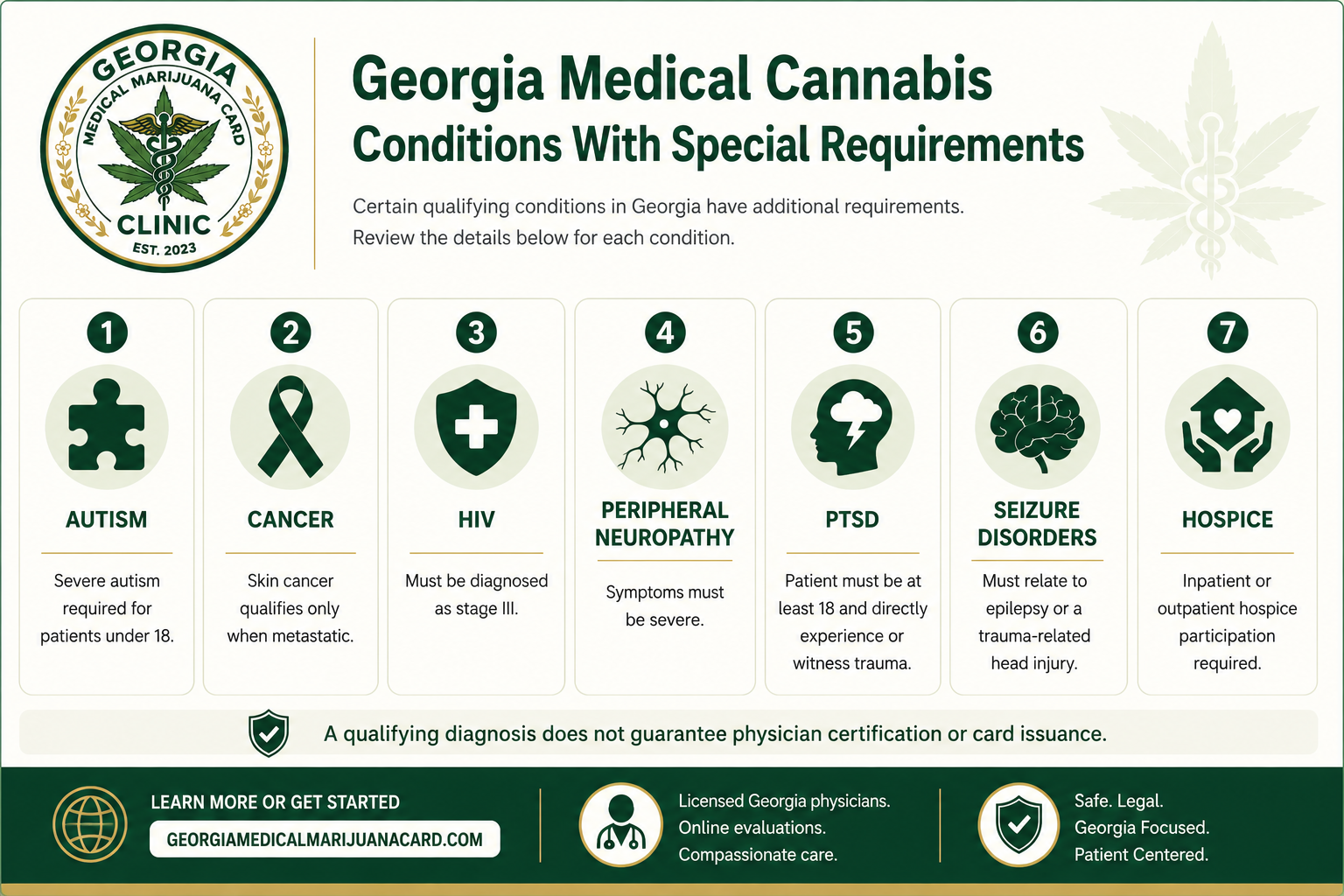
Several other conditions have specific restrictions
Pay particular attention to these requirements:
Autism has different wording for adult and minor patients.
Skin cancer qualifies only when it is metastatic.
HIV must be diagnosed as stage III.
Peripheral neuropathy symptoms must be severe.
PTSD has both an age and trauma-exposure requirement.
Seizure disorders must be related to epilepsy or trauma-related head injuries.
Hospice eligibility requires participation in an inpatient or outpatient hospice program.
These distinctions are part of Georgia’s current published eligibility list.
What Kind of Doctor Can Certify a Patient?
Only licensed physicians can certify patients for medical cannabis in Georgia. Georgia requires fully licensed physicians with a principal practice location in Georgia to evaluate, certify, and manage patients. A physician determines whether medical cannabis certification is medically appropriate.
The physician must:
Have an established physician-patient relationship
Assess the patient’s medical history and current condition
Perform or review appropriate diagnostic tests
Determine whether the patient has a qualifying condition
Decide whether certification is medically appropriate
Complete and submit the required Medical Cannabis Certification
Add the necessary patient and caregiver information to the registry
Be registered with the Georgia Department of Public Health, as patients aged 18 or older must receive certification from a physician registered with the Georgia Department of Public Health
GMMC offers a private 15-minute phone consultation. Our team sends an eVisit link after you book on Calendly.
The physician’s certification is not a prescription. Physicians are not required to certify every patient who has a listed condition.
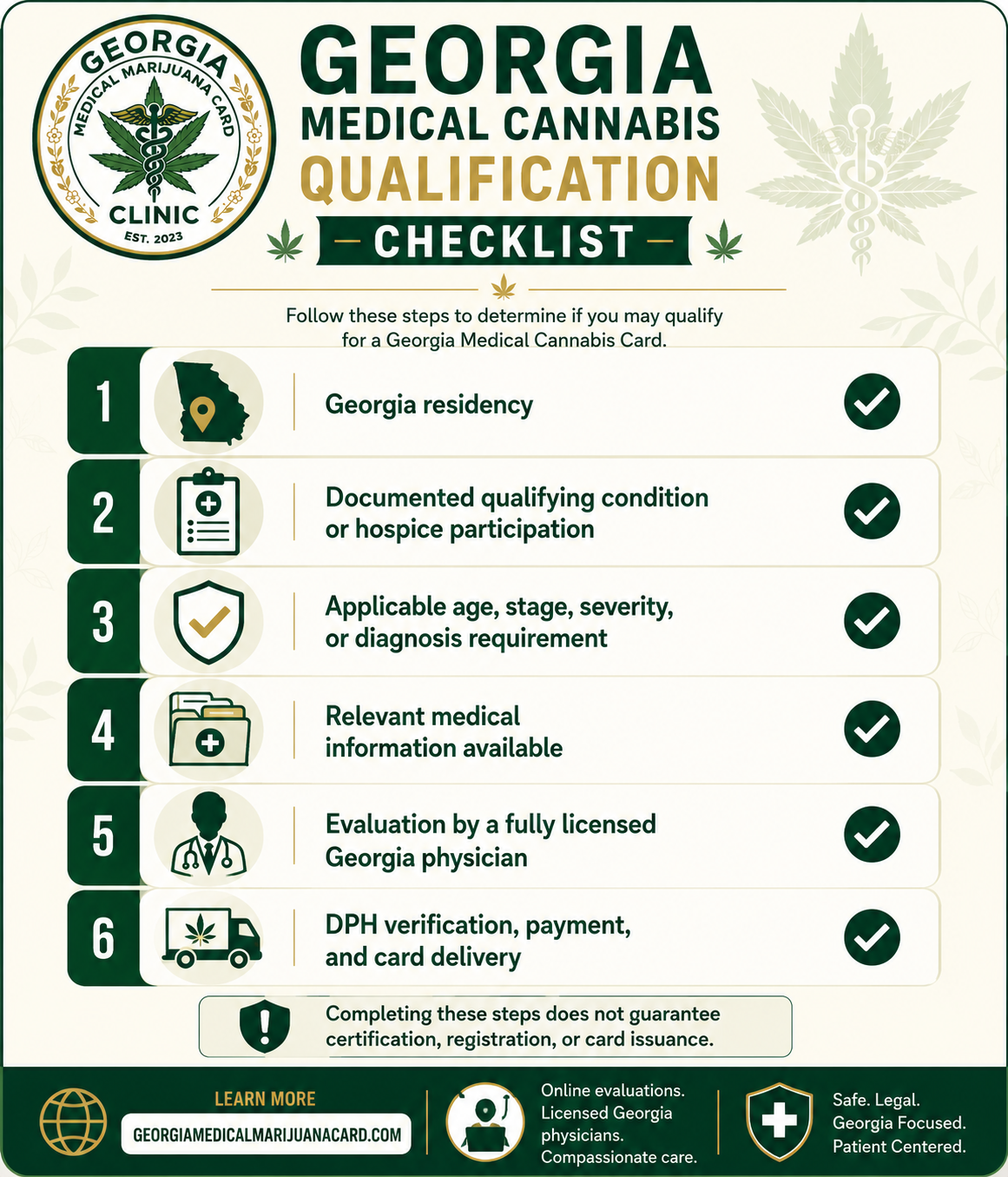
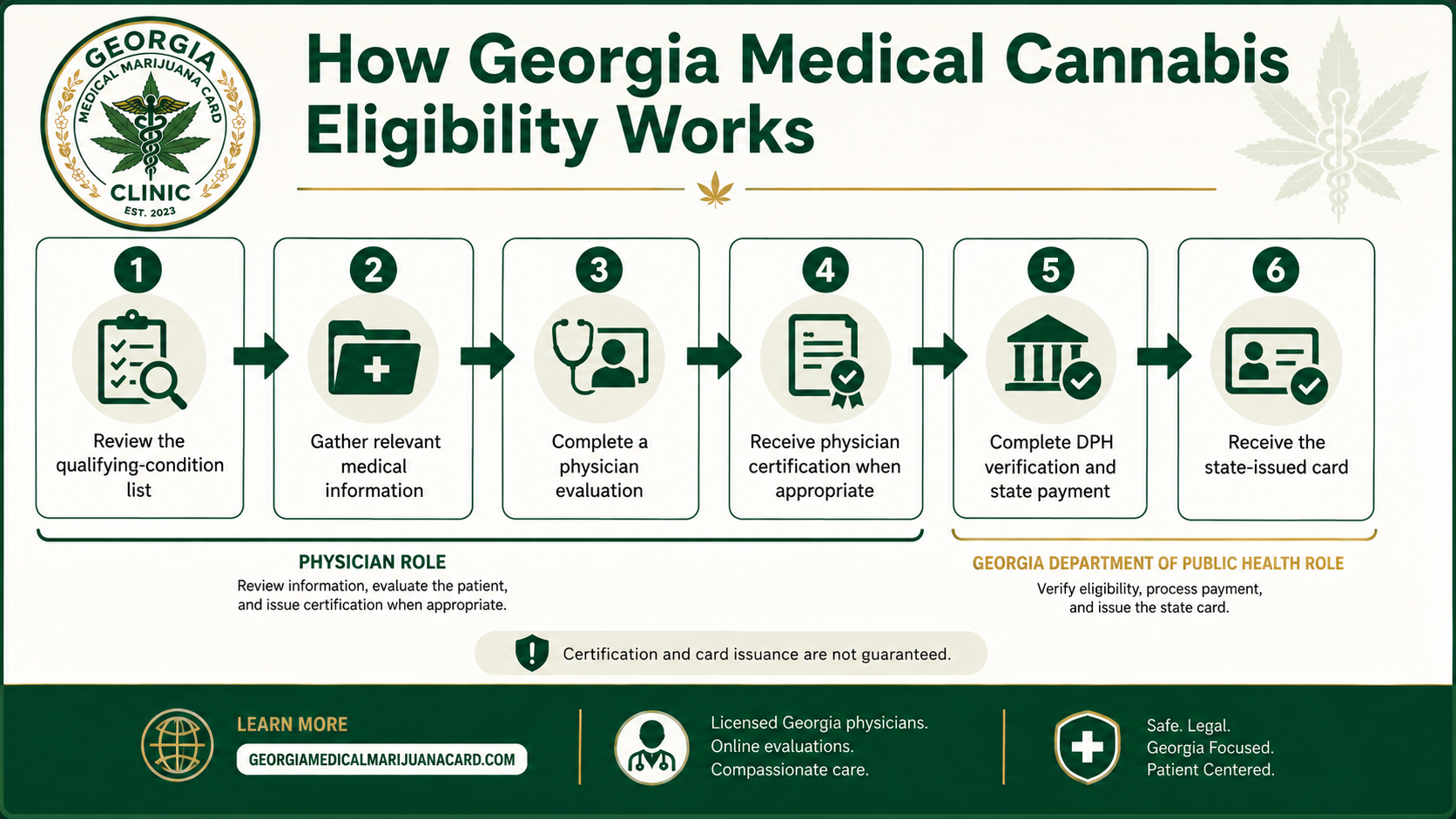
How Georgia Medical Cannabis Eligibility Works
Qualifying condition → Physician evaluation → Certification when appropriate → DPH verification → State payment → Card delivery
1. Review the qualifying-condition list
Start by confirming that the patient’s diagnosis appears on Georgia’s current list.
Check carefully for any condition-specific requirement involving:
Age
Disease stage
Symptom severity
Trauma exposure
Hospice enrollment
The cause of a seizure disorder
2. Gather relevant information
The physician may need to review information such as:
Medical history
Current diagnoses
Available medical records
Diagnostic test results
Medication information
Valid identification
Caregiver information, when applicable
The exact information requested can vary based on the patient’s circumstances and the evaluating clinic. Follow the physician's instructions for any required certification or consent documents.
3. Complete a physician evaluation
During the evaluation, the certifying physician reviews the patient’s history, diagnosis, current medical condition, and relevant documentation.
The physician—not the patient, clinic, or DPH—makes the medical-certification decision. A listed diagnosis does not require a physician to certify the patient.
Review the Georgia Medical Cannabis card process for the steps from evaluation through card issuance.
4. Physician certification and registry entry
When the physician decides to certify a patient, this step is part of Georgia's medical cannabis program: only physicians who are fully licensed and have a principal place of practice in Georgia may complete the required Medical Cannabis Certification and enter Georgia patients and caregiver information into the Medical Cannabis Patient Registry, which leads to issuance of a medical cannabis registry card if DPH verifies the submission.
The physician also files the certification in the patient’s medical record. Georgia generally requires annual physician certification, with an exception for patients with incurable or irreversible conditions, and registered patients should confirm with their certifying physician or Georgia DPH whether this applies to their documented condition and registry record. This certification is the legal step patients use to legally access medical cannabis in Georgia.
This authorization confirms eligibility under the program. It is not a prescription.
5. DPH verification and state payment
DPH reviews the information submitted by the physician. When the information is verified, DPH sends the patient or caregiver an email with payment instructions.
The state fee is $30 per card. Paying through the DPH online portal adds a $3.75 service fee. DPH states that payment must be submitted within 60 days or the card request may be canceled.
6. Card delivery
After payment is processed, DPH ships the card to the mailing address on file. A signature is required for delivery. You should have a secure home address for UPS delivery with signature required, or arrange pickup at a health department location if you do not have one or you use a P.O. Box. In that situation, the card may be sent to the health department location nearest you for pickup.
DPH advises allowing up to 10 business days after payment is processed. This is a state estimate, not a guaranteed delivery time.
Review GMMC’s current evaluation pricing and our GA Medical Marijuana Card guide before scheduling.
Caregivers and GMMC’s Adults-Only Service
The state may issue separate cards to eligible caregivers, including an adult designated to assist an eligible patient. Caregiver registration and card issuance are separate from the patient's physician assessment. Each issued card has its own state fee.
Follow Georgia DPH’s guidance for the applicable caregiver arrangement. GMMC’s consultations are for adults age 18 and older.
Frequently Asked Questions
Does anxiety qualify for a medical marijuana card in Georgia?
Anxiety by itself is not listed as a Georgia qualifying condition.
PTSD is listed, but the patient must be at least 18 and the PTSD must result from direct exposure to or witnessing a trauma. Anxiety and PTSD should not be treated as interchangeable diagnoses.
A person with anxiety may also have a separate qualifying condition, but a licensed physician must evaluate the individual circumstances.
Does depression qualify in Georgia?
Depression is not independently included on Georgia’s current qualifying-condition list.
A patient with depression may also have another documented condition that appears on the list. Having that other diagnosis does not guarantee certification.
Do migraines qualify for a Georgia Medical Cannabis card?
Migraines are not separately named on Georgia’s current qualifying-condition list.
Georgia recognizes intractable pain, but a migraine diagnosis does not automatically meet that requirement. A physician must evaluate the diagnosis, medical history, and relevant documentation.
Does chronic pain qualify in Georgia?
Chronic pain in general is not independently listed. Georgia specifically recognizes intractable pain that persists despite other medical treatment.
Patients should not assume that every form of persistent or long-term pain qualifies. A physician must determine whether the documented condition meets Georgia’s applicable requirements.
Does Post Traumatic Stress Disorder Qualify in Georgia?
PTSD may qualify when the patient is at least 18 and the condition results from directly experiencing or witnessing a trauma, so some adults may qualify for medical marijuana only if those state requirements are met and a Georgia-licensed physician confirms certification is appropriate.
A PTSD diagnosis does not guarantee certification. The physician must evaluate the patient and determine whether certification is medically appropriate.
Read more about PTSD and medical cannabis eligibility in Georgia.
Do patients need to be Georgia residents?
Yes. Georgia DPH states that patients must meet Georgia residency requirements and have at least one qualifying condition. Show proof of residency through current identification and appropriate residency documents. If an ID does not show a Georgia address, use supplemental proof such as a medical bill or phone bill listing the patient’s full name and street address.
The physician submits identification and certification information for the medical card through the Medical Cannabis Patient Registry.
How much does the Georgia Medical Cannabis card cost?
The state card fee for Georgia’s Medical Cannabis card, also called the low THC oil card, is $30 per patient or caregiver card. The DPH online payment portal adds a $3.75 service fee.
Health insurance does not cover the state card fee. The physician evaluation is a separate service with a separate cost.
Review GMMC’s current evaluation pricing.
How long does it take to receive the card?
DPH advises allowing up to 10 business days after the state processes the card payment.
The physician evaluation, certification decision, registry verification, payment, and delivery are separate steps. No clinic should guarantee a specific state processing or delivery time.
How long is a Georgia Medical Cannabis card valid?
The physical card is valid for five years. The expiration date appears on the front of the card.
Georgia generally requires annual physician certification, but SB 220 (2026), page 22, exempts patients with incurable or irreversible conditions. The five-year card expiration and annual physician certification are separate requirements.
How do I renew my Georgia Medical Cannabis card?
DPH states that a cardholder must consult with a physician to renew the card after its five-year validity period.
Card renewal and annual physician certification, when required, are separate. Patients should check the expiration date printed on their card and confirm the current renewal steps with their physician and DPH before the card expires.
Renewal, continued certification, and card issuance are not automatic or guaranteed.
Are unexpired Low THC Oil Registry Cards still valid?
Yes. An unexpired Low THC Oil Registry Card remains valid even though Georgia has renamed the program to the Medical Cannabis Patient Registry.
Replacement cards and newly issued cards use the updated Medical Cannabis program name.
Does having a qualifying condition guarantee approval?
No.
Registered patients and caregivers with a valid registry card may possess authorized medical cannabis products containing up to 12,000 milligrams of THC, in manufacturer-labeled pharmaceutical containers.
GMMC does not guarantee certification, card issuance, processing time, symptom relief, or a medical outcome. A registry card does not provide blanket protection from criminal prosecution or override state and federal law. Possession by an unauthorized person is not protected by another person's card.
Caregiver Support and Medical Care
An eligible adult caregiver may assist a registered patient with purchasing, possessing, or administering medical cannabis under the state's requirements. Georgia also recognizes a qualifying health care institution where the patient is receiving health or medical care when applicable requirements are met. Follow official DPH guidance for the specific caregiver arrangement and whether the institution permits possession and use on its premises.
A medical cannabis registry card does not replace care from your treating physician. Keep your current care team informed about medical cannabis products, medicines, and relevant safety concerns. Certification is an eligibility assessment, not a promise that medical marijuana treatment will help every symptom. Do not change prescribed medical treatment based only on a website description.
Medical Cannabis Registry Card and Current Georgia Rules
Use current Georgia Department of Public Health guidance for eligibility rather than older summaries that attach a severe or end-stage requirement to every condition. The physician reviews the documented medical history and applicable requirement.
An active medical cannabis registry card permits only the access allowed by Georgia's medical cannabis program. It does not make every form of marijuana legal. Check the Georgia Access to Medical Cannabis Commission for current authorized sellers and product rules. State registry enrollment and a later purchase from a licensed dispensary are separate steps.
Ready to Discuss Your Eligibility?
Think you may have one of Georgia’s qualifying conditions?
Book a $100 Consultation to discuss your medical history and available supporting information with a Georgia-licensed physician.
The physician determines whether certification is medically appropriate. Scheduling or paying for the consultation does not guarantee certification, registry verification, or card issuance.
This page provides general educational information and is not personal medical or legal advice. State-licensed medical cannabis remains subject to state and federal law. Georgia laws, qualifying conditions, fees, and agency procedures may change. Consult an appropriately licensed physician about medical eligibility, official Georgia sources for current program requirements, and a licensed Georgia attorney for legal questions.